Authorized international sales agent for Sichuan Weizhen Hi-Tech Material Co., Ltd.
AOD-refined meltRotating mouldMould wallMolten layer, held by rotationSolidifying from the outside inSolution treatmentControlled coolingMachined surfaceAs-cast surfaceLength up to 4,200 mmØ up to 1,600 mmMachined: Ra 0.8 to 6.3 µm
Authorized international sales agent · Sichuan Weizhen Hi-Tech Material Co., Ltd.
Precision, cast under force.
Centrifugal castings up to Ø1,600 mm, sand castings up to 15,000 kg and 3D sand-printed castings in duplex, super duplex, austenitic and nickel-based alloys. One integrated foundry, represented internationally.
Charges are melted in medium-frequency induction furnaces, then refined in an AOD converter. Argon oxygen decarburisation takes carbon, phosphorus and sulphur down to very low levels: the foundation for duplex, super duplex and nickel-based grades.
Induction melting
AOD refining
Chemistry to specification
02Spin
Force does the forming.
The melt is poured into a rotating mould. Centrifugal force presses it against the mould wall while pour volume, flow rate and temperature are monitored and controlled. Rotation speed and casting time set the wall thickness.
Horizontal and vertical machines
Controlled pour
Wall set by speed and time
03Solidify
Dense where it matters.
The wall solidifies under pressure from the mould inwards. Gas bubbles and lighter impurities are driven towards the bore, away from the working section, leaving a dense wall with a uniform grain structure.
Uniform grain structure
High density
One piece, no seam
04Heat treat
Properties are set in the furnace.
Furnaces rated to 1,200 °C and solution pools deliver solution annealing, normalising, tempering and stress relieving, so each alloy reaches the mechanical and corrosion properties it was specified for.
Furnaces to 1,200 °C
Solution annealing
Stress relieving
05Machine
From casting to drawing.
CNC and conventional turning, boring, milling, drilling and grinding bring the casting to its drawing dimensions and remove the bore layer. Parts ship as cast, rough machined or finish machined.
CNC turning and boring
Gantry milling
Three delivery conditions
06Verify
Nothing ships on assumption.
Chemical analysis, mechanical testing, penetrant, radiographic and ultrasonic examination, three-coordinate measurement and 3D scanning document every casting against its specification.
PT, RT, UT
CMM and 3D scanning
Chemistry and mechanical tests
Wall sectionschematic
Ø 1,600 mm
max. centrifugal diameter
15,000 kg
max. single casting
2,200 × 1,000 × 800 mm
3D sand-print envelope
StateFinished component
ACapability envelope
One foundry. The full route from melt to measured part.
15,000kg
Maximum single casting weight
1,600mm
Maximum centrifugal casting diameter
7,500mm
Maximum suction roll shell length
1,200°C
Heat treatment furnace rating
40,000m²
Production site
300+
Centrifugal moulds held in house
Source: manufacturer’s published data, November 2026.
BThree forming routes
The process follows the part, not the other way round.
Rotationally symmetric shells are spun. Complex housings are poured in sand. Geometry that no pattern can release is printed. All three share the same melt shop, heat treatment, machining and inspection.
A rotating shell lives or dies by the soundness of its wall. Pick a conventional route and compare what happens inside the metal.
ConventionalStatic gravity casting
vs
Weizhen routeCentrifugal casting
Aspect
Static gravity casting
Centrifugal casting
Feeding
Gravity fills the mould. Risers have to feed shrinkage as the section freezes.
Centrifugal pressure feeds the wall continuously while it solidifies.
Soundness
Gas and inclusions can stay distributed through the section.
Gas bubbles and lighter impurities are driven to the bore, away from the working wall.
Structure
Grain structure varies with section size and feeding distance.
Uniform grain structure around the full circumference.
Aspect
Rolled and welded shell
Centrifugal casting
Construction
Plate is rolled to a cylinder and closed with a longitudinal weld.
One piece. No seam anywhere in the load-bearing wall.
Integrity
The weld and its heat-affected zone must be inspected and can govern fatigue life.
The manufacturer cites better fatigue life and pressure containment than welded parts.
Wall
Wall thickness is fixed by the plate that is available.
Wall thickness is set by rotation speed and casting time.
Aspect
Forged or ring-rolled blank
Centrifugal casting
Stock
Shaped from solid billet, with heavy stock removal to reach a thin wall.
Cast close to the final wall, so far less material is machined away.
Properties
The reference for strength in rotating parts.
Tensile strength and wear resistance the manufacturer describes as comparable to forged parts.
Economics
Tooling and material cost climb steeply with diameter.
More cost-effective than forging for parts with similar properties, according to the manufacturer.
Cross-sections are schematic. Comparative statements reflect general process characteristics and the manufacturer’s published claims; suitability always depends on design code, alloy and duty.
DProduct range
Components for machines that are not allowed to stop.
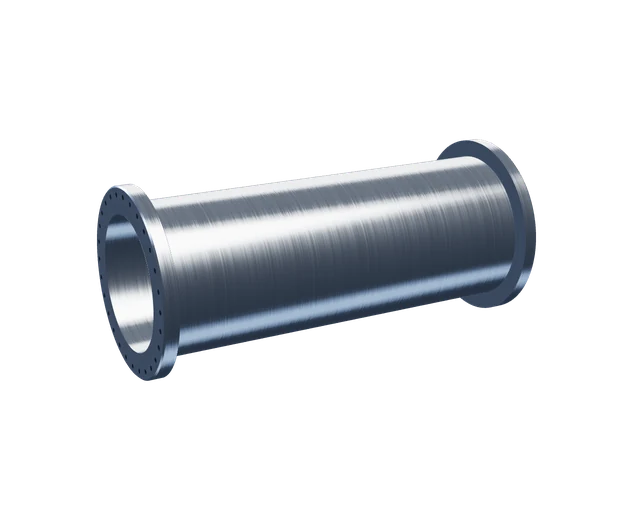
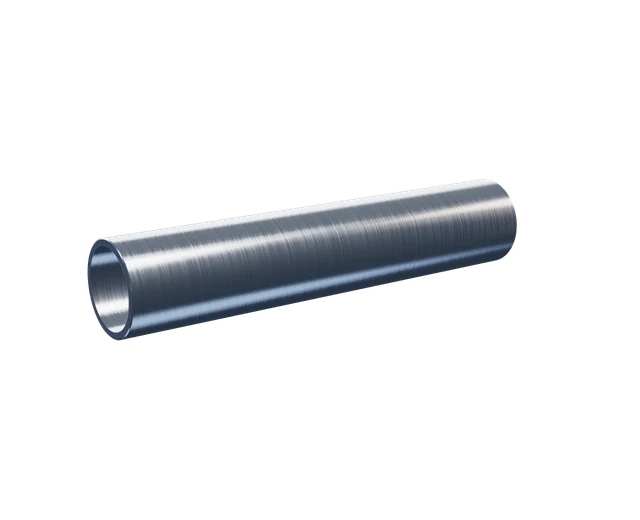
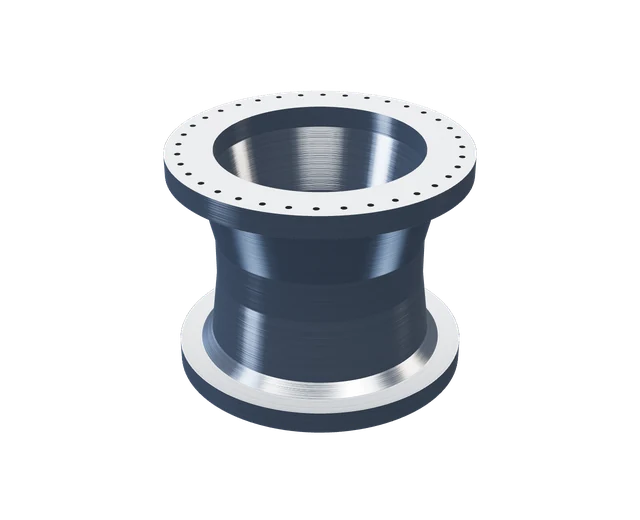
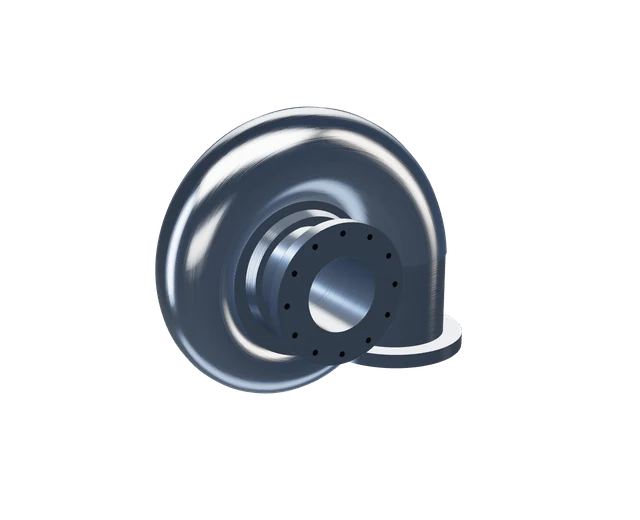
Rotating, pressure-retaining and corrosion-facing parts, supplied as cast, rough machined or finish machined to your drawing.
This platform is the international sales interface for the foundry. You deal with one contact; the engineering, metallurgy and production stay where they belong, in the foundry.
Send drawings or a description of the part, the alloy or the service conditions, quantities and the delivery condition you need.
02
Technical review
The foundry’s engineers assess castability, select the forming route and define heat treatment, machining and inspection scope.
03
Quotation and follow-up
You receive a quotation with the confirmed technical basis, and a single point of contact from order to shipment.
Next step
Send the drawing. We return a manufacturing route.
Share geometry, alloy and duty. The foundry’s engineers review every inquiry for the casting process, heat treatment, machining condition and inspection scope that fit the part.